
Cat Key Resources – Providing positive human-cat interaction
Cats in most situations like to feel in control of all aspects of day-to-day life. When it comes to human-cat contact this key resource is overlooked because we “all love our pets” but as cat owners, we often get over-affectionate, for example, we pick them up, cuddle them close, and kiss their faces. When it comes to showing love, we should bear this in mind as it is our cat that should give us permission to stroke and give them affection.
So, what does positive human-cat interaction look like?

If a cat comes over to you, you should bend down, give them your hand in a loose cup shape and offer it to them so the cat can check your scent. If they nudge your hand that is permission to go ahead and touch them. As a rule, I would stick to the head and neck and rub, scratch or pet for about 3 seconds. If they nudge again, that’s asking for more so repeat.
However, if they sniff you and don’t advance that’s their way of saying ‘No’ and then you should just leave them.
There is a ‘petting threshold’, and some cats will prefer a few seconds and some a few minutes but always look at their body language. If their ears turn away or flatten and their tails swish, that is a warning and if you persist, they may bite or swipe.
Does your cat need picking up?
Of all the cat’s I cat-sit only half a dozen are happy to be picked up at all. Look at the cat’s body language, if its ears are back and its tail is swishing it is unhappy. As humans, we perceive a ‘hug’ to be bringing someone or our pet, in close to our body and putting our face in close or kissing them. Whilst this hug may be great for you your cat senses this differently. Once you pick a cat up then they can’t get away and so they see this as a perceived threat. Some cats do genuinely like to be picked up and if they have given you permission, ensure their back legs are supported and they are against your body. Never pick a cat up by the scruff of the neck.
TOP TIP: Less is more.
Stroking your cat can release serotonin and bring down your blood pressure, however, it is always good to allow your cat to give you the go-ahead for an affectionate stroke and ensure you are not overdoing it. Know when it is okay and when to stop.
Beware the belly rub
A belly roll, exposing their belly to you is not a cue or permission to stroke, it is a trusting position and can be a sign of contentment, but it is always on their terms. Again, look for the body language cues and ensure they have given you permission to touch with a sniff and nudge first.
Lap-Cats
Often cats will come and find us to say ‘hello’ and sometimes to sit with you or on your lap. They might do this and 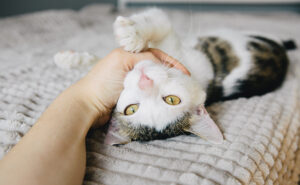 only stay on your lap for a short amount of time and this may be because you stroke them, or stroke them too much. As with my top tip, less is more and if you don’t stroke them, they might stay for longer, it is the company and warmth they seek, not always a need to be touched.
Build trust and get to know them
All cats are different. Some like certain textures when you interact with them, they might knead a fleece blanket, drool on a wool jumper, or suck on your buttons. This can be a link back to when they were kittens, suckling from their mothers. Their background can also relate to how much attention they like to seek. Wild roaming and more feral cats aren’t used to a high level of attention, and some cats prefer a warm lap but no strokes, or to be held closely. Remember if you have the scent of another cat or animal on you your cat may be wary. Look to add play into your daily routine with your cat as this can help build up a good relationship.
Top Tip: Cats like regular contact that is low intensity, so occasional strokes and rubs to the head, chin, and neck are what cats love.
Read about the other cat key resources
Other cat key resources include scratching posts, play, water, litter, food and chemical interpretation.
Having behaviour trouble?
Medical reasons should be ruled out first before contacting me for a consultation: email zoe@thefriendlypetnurse.co.uk or get in touch by phone on 07917094715
Comments