
Cat Key Resources – Scratching Posts
As part of my preventative care ethos, I am working through the day-to-day things our pet cats need to keep them healthy, happy and a little more stress-free. Ensuring they lead a happy life can give them a longer life and benefit not only them but us  too. Having blogged about litter, I’m going to move on to the issue of scratching…
Why do cats scratch?
Scratching is obviously a natural cat behaviour that you should expect to see. It serves many purposes:
- To sharpen and condition claws. Cats use their claws for all manner of behaviour, from keeping them ready for climbing to catching prey. Scratching conditions them and can help remove the old sheath.
- Retraction exercise. Using muscles in their paw to extend and retract a claw.
- To stretch their muscles, a lot like yoga. That’s why you will often see them reach high onto a post or have a full-body stretch.
- Visual marker, showing presence to other cats: ‘I live here, and I will show other cats that I do by scratching this’
- Olfactory. Cats have scent glands in their feet, again scratching is a marker, but this marker is for your nose and the noses of other cats.
 If you have a cat that ventures outside you might expect them to scratch outside, using trees and fence posts. However, a cat will also scratch inside too, as above, scratching acts as various types of markers, so your cat will want these wherever they live and roam.
Obviously, an indoor-only cat has no option but to scratch indoors and it is vital they have space to do so, not only for the above reasons but to deny it can lead to many problems.
Where is best for scratching?
Going back to wild cats’ ancestry, they would tend to scratch at entry and exit points, usually when they have woken up and after eating. Bear this in mind when establishing what location is best suited for a scratching post or tower. If you find your cat does not use the post it may be because of this, so think; location, location, location.
Size of scratching furniture
Does your cat like to scratch vertically or horizontally?
 If they like to scratch vertically make sure the scratch furniture is high enough, and horizontally try boards that lie flat with either cardboard or sisal.
Be sure to upgrade your scratching furniture as your cat grows up from a kitten as they need to be able to get full purchase or allowance on the scratching furniture. If your cat worries about it toppling over or does not feel like it can take its weight, it won’t use it and will resort to using your sofa or chair.
Scratching furniture can come in all shapes and sizes, however from my experience cat towers and cat trees are great, they often have different levels and offer more than one scratching post. Ideally get one that is breed specific, for example, a Maine Coon may prefer something that resembles a log or tree. You will also find most posts are covered in sisal rope as cats are drawn to the texture when their claws work through it.
When weathered you should replace it maybe every 3-4 years and if you are given one-second hand be sure to rub it down with your cat’s scent. You can, of course, make your cat scratch furniture by using sisal rope and craft items.
Cat scratching problems
If your cat uses scratching as a marker and is marking your furniture it may be a behavioural concern. Reasons may include inter-cat conflict, and this could result in 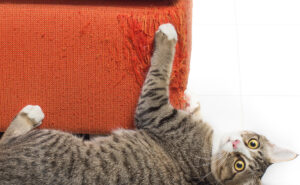 more scratching. Scratching can be deterred; however, it is always better to provide an alternative. Try moving your post first to see if the location is an issue. Try rubbing it with their scent and marking it with a nail to try to work the material.
Don’t tell off your cat or spray water at them as it may be an anxiety-based issue and you could increase the problem. Some owners think cats scratch to get your attention, but this isn’t the case. Ask yourself ‘what options do they have to scratch?’
Still having trouble?
Book a consultation now, simply chose which method of contact might be best to start, I look forward to hearing from you;
Email [opens new email]
Web contact form >>
Call: 07917094715
Qualified Vet Nurse & Behavioural Specialist
- Achieved, Distinction in Advanced Diploma in Applied Animal Behaviour (Feline) Level 5
- International Society of Feline Medicine (ISFM) certified feline-friendly nurse
- ISFM Advanced Certificate in Feline Behaviour (AdvCertFB) with distinction
- Qualified Veterinary Nurse with the Royal College of Veterinary Surgeons (RCVS)
- A Registered Veterinary Nurse (RVN)
- Working:
In an Orthopaedic and Neurology Referral Centre
As The Friendly Pet Nurse
Comments