
Cat Key Resources – Litter trays
In the coming months, I’m going to be covering some of our pet cats’ key resources. These resources at the things they require day to day and to ensure they are healthy and happy. It is part of my preventative care as a vet nurse. Setting up your pet and continuing to look after it is key to being a responsible pet owner, but also to ensuring they lead a long life. I see many pet problems that are avoidable and with a little friendly advice, such as this, we can all benefit. So have a read and see if your cat’s litter needs are met.
Cat litter tray size; big enough to turn?
Many cat litter trays are too small. The majority on the market, at pet stores and online, do not give your cat enough room. Your cat litter tray should be at least one and a half times the length of your cat from tail to nose. Therefore, your cat should be able to turn inside the tray easily.
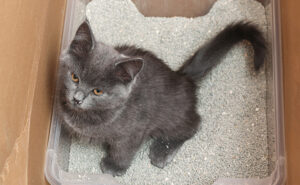 Also, think about the breed and age of your cat. As your cat grows so should the litter tray, from kitten to adult, the litter tray needs to accommodate the size. This is also true of larger breeds of cats. For older cats, remember they won’t or can’t step into a high-stepped tray, so a lower step is needed.
Litter tray hack: rather than pay for expensive large litter trays use an under-bed storage box, the plastic ones that usually have a lid for toys. Cut a hole in one end, to be a ledge to step in and out of. Such boxes can easily be adapted… think outside the tray!
Did you know, that a cat will still use a litter tray indoors even if it has access to an outdoor area? This may be because another cat has been using its space and it feels uncomfortable outside. If a cat feels it may be ambushed it will find a safe space to go to the toilet, and that may be your indoor tray.
Type and location of litter tray for your cat/s
Cats are very private animals, think of a public toilet, would you use one that doesn’t have a lock? Would you use one that isn’t clean? Would you use one if it was a loud space without much seclusion? Some cats want to be private and secure so a hooded litter tray may benefit this type of cat. However, in multiple cat situations, fear of an ambush or conflict can make a cat avoid using the tray if it’s worried about whose waiting outside to attack.
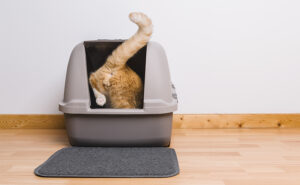 This is the same for location. Think about your toilet, it should be a private place, ideally quiet. Same with your litter tray, don’t place it in the busiest room in the house. If your cat has to battle playing children to have a pee or poo it will avoid the tray and holding onto urine can cause medical issues. Keep away from kitchen appliances, and if it is situated in a corner, they may feel less likely to worry about what’s behind them.
Location hack: Underneath the stairs is a great place for litter trays. I’ve seen trays placed behind holes in a panel. Usually, that space is empty as it is too low, so a litter space is perfect. Also, litter trays in bathrooms are another good location, I mean, it’s where you go, so why not the cat?!
What is the best type of litter for cats?
Cats’ origin is from the African desert, so a finer grain is more natural for cats. If you were to stand in the litter tray with bare feet, how would it feel? A wood chip doesn’t feel good, believe me, I’ve tried, so think about your cat. A fine grain that offers to clump is best and isn’t too scented for cats. I am not allowed to promote types of litter but feel to message me for suggestions.
Did you know, cats mark their territory? They use urine and faeces to mark and the act of leaving faeces uncovered is a clear sign to others of their presence.
The golden rule of litter trays
For the best optimisation of your cat’s environment, one litter tray per cat, plus one extra is the golden rule. If you have a social or bonded group you could have one per group, however, if you have three or more cats one tray is not enough.
Some cats will not want to poo where they have peed so supplying an additional box allows for this. But don’t place the tray’s side by side, as cats think of this as one tray. They must be in separate areas. Not near food or water, and ideally on every floor of the house. Just think, if you need to urgently pee would you appreciate having to go two floors to find the nearest toilet?
Management and cleaning of litter trays
Ideally, if you use a clumping litter, management is easier as you can scoop once or twice a day and replenish once or twice a week. Give it a thorough clean with non-scented washing-up liquid. Avoid using scented deodoriser or scented litter liners as these are an offence to cats.
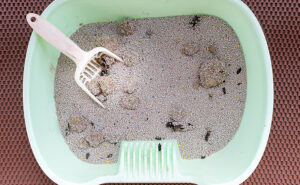 Beware, covered trays can end up like a festival toilet, especially with a multi-cat household, so think about the plastic box idea and maintain them daily. Litter liners are a no as cats don’t like to catch their claws on plastic and many are scented, save plastic and the environment by lining it with paper and scooping out the clumps. Although some clumping litters are best off just in the tray on their own to allow it to clump efficiently.
Older cats and litter trays
It’s important to think about your elderly cat, if it is spending time upstairs then place a tray up there in addition to downstairs. This allows for slow-moving cats to always have access to the loo if they need it. If your cat hasn’t used a litter tray and usually goes out, think about having one in your home to avoid accidents, as accessing the garden via a flap can be difficult with arthritis.
Cat issues? I’m here to help
If your cat is toileting outside of the tray, it could be a health problem. Ensure you visit your vet to get it checked out. If your cat is healthy, it may be a behavioural issue. With an Advanced Diploma in Applied Feline Behaviour, I can offer feline behaviour consultations with a great deal of expertise. Contact me to set up a consultation.
Comments