
Achieved the Advance Diploma in Feline Behaviour Management
It is with great pride that I announce I have successfully passed, with distinction, my Advanced Diploma in Applied Animal Behaviour, Feline, Level 5 from Compass Education and Training.
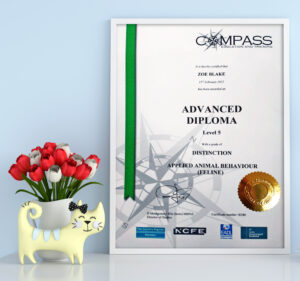 So, 3 years and over 400 hours of study, I’m through! As you all know, this also included working as a veterinary nurse for VetCheck in addition to other local practices, attending to my lovely Friendly Pet Nurse clients and above all, being a parent. The pandemic saw an increase in work, but also homeschooling. It has been tough juggling all these roles, but this diploma has given me valuable insights into feline behaviour, and more.
Cat behaviour is complex
The diploma covered 12 modules, see below, broken down into everything from feline laws, where cats originate, to how their brains work and health topics within biology. It has given me a real foundation and insightful knowledge into cat behaviour and given me the tools to progress case studies and provide the help owners so desperately need.
Feline certificates
Having previously studied and completed the ISFM advance cat behaviour and other feline based courses, this diploma is the equivalent of a foundation degree and ensures I can offer feline behaviour consultations with a great deal of expertise. It is also a milestone in my veterinary nurse journey, from obtaining my RVN qualification to building up feline understanding and comprehension that I can use to help those who are having issues with their pet cats or struggling with them and their relationships. The diploma is also recognised by the Animal Behaviour Council (ABC) and the Association of Pet Behaviour Counsellors (APBC).
Veterinary Nurse of the Year Nomination
 As if getting a distinction and finishing my diploma wasn’t enough one of my clients also nominated me for PetPlan’s Vet Nurse of the Year 2022. I did not make the finalists but thank you to all those who nominated me. I’m so happy and glad to receive it and very flattered.
Do you need a feline consultation?
With my study completed, I am now open to consultations. If you have a cat behaviour issue, such as two cats not getting along, catfighting, or your cat urinating where they shouldn’t, scratching furniture, being nervous or anxious, I can help. Contact me, you can also read a brief overview of how the consultations work.
Qualified Vet Nurse & Behavioural Specialist
- Achieved, Distinction in Advanced Diploma in Applied Animal Behaviour (Feline) Level 5
- International’s Society of Feline Medicine (ISFM) certified feline friendly nurse
- ISFM Advanced Certificate in Feline Behaviour (AdvCertFB) with distinction
- Qualified Veterinary Nurse with the Royal College of Veterinary Surgeons (RCVS)
- A Registered Veterinary Nurse (RVN)
- Registered with the British Veterinary Nursing Association (BVNA)
- Working:
In an Orthopaedic and Neurology Referral Centre
As The Friendly Pet Nurse
Veterinary nurse for VetCheck
Summary of modules completed for my ADVANCED DIPLOMA IN APPLIED ANIMAL BEHAVIOUR (FELINE) (level 5)
- Learning theory.
Classical and operant conditioning, one-trial learning, habituation, positive and negative reinforcement, reinforcement schedules and punishment, individual differences biological factors affecting learning and accidental learning. - Genetics and evolutionary explanations of behaviour.
The terminology is associated with genetics; cell division; Mendel and Mendelian forms of inheritance. The multi-factorial nature of the expression of different physical and behavioural characteristics. Theories behind the evolution of the domestic cat. The problems associated with artificial selection. - Bio-psychology.
The structure and function of each component of the mammalian brain. The development of the feline senses and the effect on the brain. - Pharmacology.
Drugs, their use, misuse, effects and unwanted (side) effects on behaviour. Veterinary terminology; how drugs act on the nervous system. The effects of health on behaviour; how pheromones impact on behaviour. - The internal environment.
The importance of thermoregulation, its influence on the metabolic system and its impact on physical form. The elements required in a balanced diet and the links between nutrition and behaviour. - The external environment.
The importance of socialisation throughout the sensitive periods and the resultant implications in later life. The acquisition of behaviour is due to varying influences of social, behavioural and cognitive factors. The effects of different types of owners on the cat. - Intelligence and theory of mind.
The concept of intelligence and the problems associated with quantifying it. Cats and emotions. Feline communication and how it differs from humans. - Behavioural diagnostics and modification.
The importance of the stages of diagnosis. The influence of different external and internal factors on behaviour. The use of body language in determining behaviour. - Professional Conduct.
The value of obtaining correct insurance. The importance of adhering to a code of practice and appreciation of regulations set out by some professional bodies. - Application of theory in training and problem prevention.
The role in behavioural management problems and the effect this has. The different sources of feline aggression. The need for psychological testing and presentation. Appropriate training methods relevant to different behaviour problems. - The Law.
How an act of parliament is formed and how this becomes law. Legislation brought in by the Animal Welfare Act 2006, its impact on existing acts and the resultant effect on owners and animal workers. The legislation related to cats under the Animal Welfare Act 2006 and the ramifications for cats and owners. - Case studies.
Understand the requirements of effectively taking case histories. Identify and critically evaluate the contributing factors including the role of environmental factors as potential causes of unwanted behaviour in a range of hypothetical cases. Prepare a formal case study report.
Find out more about cat issues and cat behaviour
There is a wealth of information on my website, including blogs about:
- Cat litter
- Fleas
- Elderly cats
- How to keep cats entertained
- Welcoming a new cat to the home
- Think Outside the Bowl campaign
So please have a browse and contact me if you need any further assistance.
Comments