
Cat Key Resources – Play
I’ve discussed litter, water, and the need to scratch and alongside these other key resources is play. Cats are born with the ability to fulfil their predatory prey needs by hunting. Nothing has been done to eliminate this from cats since they have been domesticated in our homes. It may seem like your bundle of fluff is the cutest thing, but really it is built for exploring, hunting, stalking and killing, so it is important they can have an outlet for prey sequences.
 Finding, stalking, chasing, pouncing, dissecting, and eating prey are all part of the sequence. Be mindful that this is part of their DNA, and they need an opportunity given to them to play in this way.
Teach play from a young age
Synthetic prey is a great way to keep you safe from claws and teeth, but this needs to be taught from an early age. When playing with kittens don’t play using your body parts, this teaches them that a human moving part is a plaything to be attacked. As tempting as a hand under the duvet or foot under a rug is, if you don’t wish to be ambushed when they are older and their claws are sharper, start, and continue with, a toy. Kittens also learn how hard to bite and scratch from their siblings and parents growing up, watching, and learning from one another.
Dangler Rod Toy, with an assortment of attachments that are changeable
The best toy to get for a cat is a type of fishing rod that has various types of attachments. These attachments come in different sizes and shapes, some mimic a bird, with feathers, and others with fake fur like a rodent.
 With a long elastic string you can move these about like that of the prey, motion is key. Maybe up high for a swooping bird or dragged along the floor like a mouse crawling as some cats prefer horizontal play and some vertical. The length is also important as cats cannot see close to their face, so look to move the toy around 50cm away from them.
The attachments may need replacing after being plucked or half-eaten, which is all part of the game.
Older cats still need to play but they may wish the game to be more static with less distance and more time to catch.
Did you know cats cannot see the whole spectrum of colours? When buying a toy look to get something that replicates the prey they like to hunt and not something shiny or rainbow-coloured. It is mainly blue and grey they can see and perhaps some yellow.
Allow the reward of winning
One controversial toy is a laser pen for cats, simply as it does not allow the reward of a catch which can lead to a  lot of frustration. In the wild the prey would be caught but then played with, tossed about, or pulled apart, a laser beam doesn’t allow this, and your cat becoming frustrated can lead to aggression. Ensure the play allows some type of winning, whether this is catching the toy, plucking it, or having a small treat at the end. This allows them to feel the adrenaline increase like they would in the wild.
Puzzle feeders help extend play
In addition to play time, you can also use puzzle feeders to add enrichment to your cat’s daily routine. By requiring them to search and explore for their food they are utilising their skills, this also allows them to forage, and problem-solve and extends feeding time. You can easily make a DIY puzzle feeder with cardboard tubes and yoghurt tubs, see my mini-site Think Outside the Bowl and my blogs on the benefits of puzzle feeding.
Did you know not all cats like catnip?
A percentage of cats are not affected by it. Dried catnip for toys also comes in different grades, so if your cat goes crazy for it, maybe you have some good stuff!
So why do they bring me dead prey?
In the wild cats would not be sure when their next feed might be, so they might bring the prey back for use later. 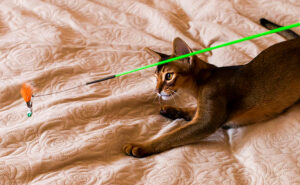 They may be proud, but the dead prey will not be for you. It may also be a learned habit, from when their parents brought back food to feed. Just think, if your cat was left out in the wild, they would manage, they are only tame inside our homes, outdoors they still have that killer instinct.
Do you have problems with an aggressive cat?
If you are struggling with your cat’s behaviour, book a consultation with me:
Email [opens new email]
Web contact form >>
Call: 07917094715
Comments