
An Introduction to The Big Cat Sanctuary
As I drove into The Big Cat Sanctuary car park, I could feel the familiar flutter in my stomach — nerves and excitement in equal measure. I was about to embark on what felt like a truly special opportunity. I closed my car door and instinctively wandered over to an enclosure overlooking the tarmac, eager to see who might be inside.
Little did I know, my arrival had not gone unnoticed.
There, gazing down at me, was a stunning leopard — fixated, observing, assessing. Was I a threat, or simply a mesmerised bystander? I stood in quiet awe, taking in the sheer beauty of this animal: the markings, the power, the presence. In that moment, the realisation hit me — I was about to encounter some truly extraordinary felines.
I clutched my folder tightly, packed full of questions. One thought echoed above the rest: are we actually living with lions in miniature?
This visit wasn’t just about wonder. I wanted to deepen my understanding, add to my feline studies, and gain evolutionary insight into the why and how of caring for our domestic cats in a way that truly honours their ancestors.
It was time to step inside.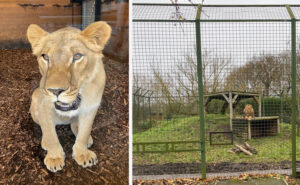
Behind the Scenes at the Sanctuary
Emily, one of the keepers, was my guide for the visit, and her passion for her role was evident from the very beginning. As she took me around the site, I was fortunate to explore many of the areas that fascinated me most — including the veterinary operating theatre and the kitchen, where food preparation and enrichment take centre stage. Both are vital components of welfare for any feline species.
Emily introduced me to the cats and generously shared her knowledge about the different species and their individual needs — from dietary preferences to the scents they love to rub all over themselves (and yes, some of them were very unexpected!).
A key focus of my visit was to discuss puzzle feeding and training — specifically how positive reinforcement is used to strengthen bonds, support welfare, and allow keepers to perform health checks or administer medication when needed. I’ll be exploring this in much more detail in a future blog, so watch this space.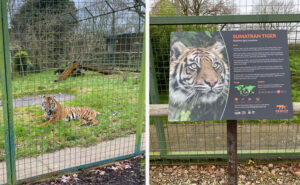
Key Learnings from The Big Cat Sanctuary
So, what were my take-home observations from this incredible place nestled in the Kent countryside? Below is a small snapshot of the questions Emily kindly answered during our discussion.
Q: How many cats live at the sanctuary?
A: There are currently around 40 cats, representing approximately 14 different species — many of which are on the IUCN Red List of endangered species.
Q: Can different species be housed together?
A: No. They don’t “speak the same language,” and housing them together would cause significant issues. Inter-species breeding is also not permitted. However, they can live as neighbours.
Q: Are they social or solitary?
A: Some species absolutely form social bonds. You can observe affiliative behaviours such as head rubbing, allo-grooming, and allo-rubbing — sound familiar? Play is often initiated, and lions in particular live within clear social hierarchies.
Q: Do they show aggression similar to domestic cats?
A: Yes. Big cats display many of the same behaviours — hissing, growling, piloerection — usually when scared or overwhelmed. In the wild, many live under chronic stress due to the constant threat of danger.
Q: What is their average lifespan?
A: In the wild, many big cats live between 6–10 years. In captivity, this can extend to 15–18 years.
Q: Do they suffer from similar medical conditions to domestic cats?
A: Yes. Kidney disease, arthritis, and dental disease are common in both big and small cats.
Q: Are different drugs used for sedation and anaesthesia?
A: No — the same drugs are used, just in much higher doses.
Q: What veterinary procedures are commonly needed?
Dental issues are frequent, so training cats to open their mouths is a crucial part of clicker training. This allows keepers to spot problems early, especially if a cat goes off its food.
Females are not neutered, which unfortunately means they can be prone to pyometra. X-rays may also be required to diagnose joint or bone issues — after all, these cats are athletes and can suffer injuries and degenerative conditions.
Q: Do they experience stress? How does it present?
Yes. Smaller cats may overgroom, while larger cats may pace, become territorial, fixate on objects, or appear generally more irritable.
Q: Do they eat a 100% meat diet?
A: Primarily yes — horse meat and venison form the main diet, alongside smaller prey such as rodents, rabbits, fish, duck, and pheasant. That said, many also enjoy enrichment foods like watermelon.
Fun (and Fascinating) Facts
- Some wild cats can go up to five weeks without a meal.
- Cheetahs are fed daily, while other species may only eat a few times a week.
- Perfume, herbs, coffee granules, and cinnamon are commonly used for scent enrichment.
- The largest lion weighs around 230kg.
- All cats are microchipped and vaccinated against the same viruses as domestic cats.
- They can suffer from ear mites but rarely fleas or ticks.
- They are wormed twice yearly and have regular faecal egg counts.
- Supplements are provided to support ageing joints.
The Question That Matters Most
My biggest question of the day was this:
Are big cats more similar to domestic cats than we think?
The answer was an unequivocal yes.
Domestic cats share far more with their wild relatives than many of us realise — in behaviour, needs, communication, and emotional responses. This realisation is something I’ll be exploring much more deeply in upcoming blogs.
Leaving Inspired
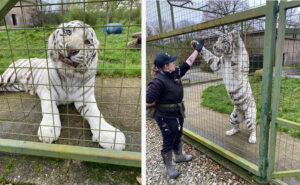 As I drove away from the sanctuary, I felt a deeper appreciation for these magnificent creatures and immense gratitude that places like this exist — places dedicated to conservation, education, and welfare.
I knew immediately that I wanted my son to experience the same magic so I booked in for us to visit. After an unusually speedy afternoon tea (fuelled purely by excitement), we headed in to meet the cats. When I later asked him what he wanted for Christmas, his answer was simple: to go back and see the cats.
I’m so glad he felt what I felt.
If you love cats — truly love them — I cannot recommend a visit enough. Please support this incredible sanctuary and follow their journey as they work tirelessly to protect cats both in captivity and in the wild.
Big Cat Sanctuary
Find out more about the Big Cat Sanctuary here: www.thebigcatsanctuary.org
Follow them on social media: Facebook > Instagram >
Read more about feline behaviour on my blogs:
- Cat Key Resources – Providing positive human-cat interaction
- Why Invest in Cat Furniture? The Real Benefits for Your Feline
- The Benefits of Enrichment for Your Feline Friend
- Vist: www.thinkoutsidethebowl.co.uk for my dedicated site about puzzle feeding
Comments