
Pet Care Q&A
Last month I was a guest on the Sounding Out Horsham podcast, here are some pet care Q&As following on from the podcast that discuss cat and dog behaviour with questions from their listeners:
Cat Question:
We rescued our cat when he was six months old, he has always been a dribbler, but he seems to be getting worse as he gets older, he is now 11 years old. Why does he dribble?
Answer:
This can be quite a common behavioural trait that cats display and can be accompanied by kneading, so they might pad with their claws when they sit on your lap. It is often perceived as a happy emotion and stems back to when a kitten. If this is the case I wouldn’t worry.
However, if it is a new behaviour, just developed it could be indicative of something going on. It could be related to dental disease, something going on with throat or nasal cavities, the cat maybe feels sick and starts to salivate. – cats who are anxious or worried may dribble. If it is a new problem then I advise getting it checked.
Read more:
Why does my cat knead me? and cat behaviour issues.
Dog Question:
Our six-year-old dog loves going to the park and is a self-taught therapy dog, who loves people and dogs. At about three years old she started to bark when in the doggy area, not specifically at a person or dog, just like she is announcing something.
Answer:
Some people believe dogs bark as communication, but let’s try to understand the emotion of the dog and what’s behind the dog barking, what are the other body language cues? Is it an excited bark, or an anxious bark? Look at the bigger picture. If there have been rewards from owners, we can inadvertently reinforce the behaviour, so the dog learns, by maybe getting attention, or a treat it then will repeat the behaviour. The dog may be uncomfortable – the dog may feel trapped, has anything happened in the past? The dog may not be happy. See dog behaviour and the aggressive ladder. We don’t want to assume the dog is happy when barking.
Read more:
Is my dog happy or sad?, also find the RSPCA dog aggression ladder.
 Dog Question:
I was walking my dog, and someone told me I shouldn’t throw a stick for them. Is this correct? I thought all dogs loved sticks!
Answer:
Sadly, sticks are not great dog toys for various reasons:
- Throwing them, the dog chases and brings them back, but sticks can cause a lot of injuries, mouth injuries, cut tongues, or even impaled.
- If chewed can get shards of the stick in the mouth.
Get an appropriate dog toy.
Check the size of the toy, is it good for your dog? A tennis ball could get stuck in the throat of a large dog.
What does your dog like? If it goes in the water, choose something that floats.
There is a massive market for dog toys, look to get something suitable for your dog.
 Cat Question:
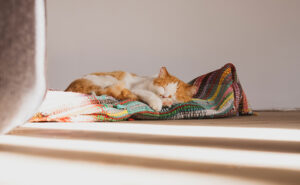
I bought my cat an expensive bed, why won’t my cat lie in it?
Answer:
If we look at cats’ ancestry, they are solidary survivors, their whole world is about being safe, being protected. They naturally change sleeping places as they don’t want to stay in the same place too much or often as they become vulnerable. A lot of the safety is an interpretation of scent, so if we bring in a new object or item it will have no scent, so to them is it unrecognised and they need to be cautious. Not unusual to get a lovely furry bed and it just sits in the corner. Maybe place the cat’s scent on the new bed, by rubbing their cheeks and then wiping the bed, placing an already used cat blanket next to it or on top. Sometimes it is the position – try moving it. Don’t be too upset or insulted. Cats cannot be steered into using a bed. Cat’s like to be up high, maybe try an empty shelf.
Read more:
Cat’s Key Resources: Sleep and Chemical Interpretation to keep safe.
Want more Q&As?
Listen to more of this Q&A on the Sounding Out Horsham Podcast.
Need help with your cat?
If you need help with general healthcare, cat advice, cat sitting, and basic grooming, I can offer home services to aid your cat/s especially if they get anxious about cat carriers or trips to the vet.
Medical reasons should be ruled out first before contacting me for a consultation: email zoe@thefriendlypetnurse.co.uk or get in touch by phone on 07917094715
Comments