
The pitfalls of ball throwing
Is your dog obsessed with retrieving a ball? Do you spend hours at the park?
 If you were to visit your local park, I guarantee you’d see someone with a ball chucker and a dog spinning excitedly expecting the ball. They enjoy the chase, the serotonin, and the process of retrieving.
However, have you ever thought if this activity is any good for your dog?
The negative considerations of ball throwing
Joint Health – ball throwing has a very high impact on the joints. In younger dogs, this is a worry. Puppies are growing and concussions on growing joints can be a concern. This high-impact activity can also adversely affect senior dogs with arthritic joints and those dogs who are overweight are more likely to get injured due to the excess weight.
Overexertion – Dogs will keep going and some breeds can overexert themselves as they become so enthusiastic about fetching the ball but are exhausted. Try to ensure you are monitoring their energy levels and don’t push them. If they stop bringing the ball back, they have probably had enough.
Damage to ligaments – If you are ball throwing in the woods or on hilly terrain, watch out for obstacles, your dog may be so focused on the ball that they don’t see hazards such as ditches, low fences, and uneven ground. This can lead to more injuries or strains, especially on the cruciate ligaments, which are those in the knee. These are most injured while jumping, skidding, twisting, or turning awkwardly.
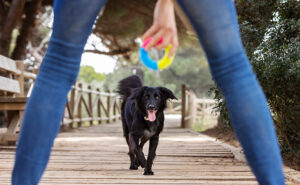 The body’s movement that goes through this process of chasing, jumping, or turning awkwardly is not great exercise. Studies show canine arthritis can be prevented with less trauma to the joints, and repetitive actions such as ball throwing.
So, what exercises can you replace ball throwing with?
- Scent work
Dogs have an amazing sense of smell. Scientists report that a dog’s sense of smell is 10,000 to 100,000 times more acute than a human’s. For every scent receptor a human has, a dog has about 50. So, use this in a game. Hide a treat or toy and get your dog to find it. here are some great enrichment ideas via the Dog’s Trust:
https://www.dogstrust.org.uk/dog-advice/life-with-your-dog/enrichment/enrichment-activities-for-dogs
https://www.dogstrust.org.uk/dog-advice/life-with-your-dog/enrichment/make-your-own-dig-box - Agility course
If you are handy look to build an agility course or find a local one to book. You can use tubes, tunnels, ramps and more. These can train your dog and keep them stimulated, working on balance and giving them confidence.
https://www.wikihow.com/Build-a-Dog-Agility-Course
https://thefriendlypetnurse.co.uk/my-own-pets-daisy-the-agility-dog/ - Jog or ride with your dog
Dogs that love to run will enjoy such activities as Canicross or Bikejor where your dog can be attached to a harness and either yourself or a bike. This way they can lead and run for miles. Find more about them here and how I also use them with my dog, Dylan:
https://www.canicross.org.uk/
https://cani-fit.com/2014/05/08/walk-before-you-bikejor/
https://thefriendlypetnurse.co.uk/my-own-pets-dylan-our-family-dog/
Try other toys
Puzzle toys, such as snuffle mats, puzzle feeders and toys that dispense treats are great for keeping that canine mind busy.
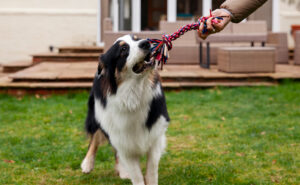 Tug toys are great for impulsive dogs and can build bonding and strength. Move it side to side and let them win from time to time!
Has this made you change your play routines?
While chasing balls can be a fantastic form of exercise for dogs, responsible dog ownership involves understanding your individual dog’s needs, and limitations and ensuring you are looking after their future health.
Look to leave the ball at home and try out some of these other exercises, your dog’s joints will thank you.
Find my Facebook page or comment below.
Could you provide a link to the studies you’ve quoted about throwing balls and canine arthritis?
You can find reference material here on the Canine Arthritis Management (CAM) website: https://caninearthritis.co.uk/what-is-arthritis/can-arthritis-be-prevented/