
Why Does My Cat Run When They See the Cat Carrier?
Have you ever got your cat’s carrier out from the cupboard or the loft and then can’t find them when you need too, like they have disappeared? You’re not alone. For many cats, the sight of the cat carrier is enough to trigger an immediate escape plan.
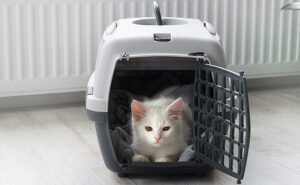 But this isn’t your cat being difficult or “bad”. It is cat behaviour driven by learning, fear and previous experiences. If the carrier has only ever appeared before a trip to the vet, your cat may have learned that carrier = something unpleasant.
And that’s where stress stacking can begin.
National Take Your Cat to the Vet Day
National Take Your Cat to the Vet Day is a useful reminder that regular veterinary care is an important part of keeping our cats healthy, even when they appear perfectly well. It is also a great opportunity to think about how your cat experiences a visit to the vet.
Preventative healthcare shouldn’t have to mean a stressful ordeal every time. Understanding your cat’s behaviour and taking steps to reduce their anxiety can make the journey, the veterinary visit and the return home much easier for everyone.
What is stress stacking in cats?
A trip to the vet can involve a whole series of unfamiliar experiences. Your cat may first have to be caught and placed into a carrier they don’t particularly like. Then comes travelling by car, public transport or on foot, with unfamiliar movement, sights and sounds. If the carrier is too small, unstable or uncomfortable, that can add to their anxiety.
Then they arrive at the veterinary practice. There may be unfamiliar smells, barking dogs and strange people. Your cat is naturally wary of dogs and, unlike a dog, they can’t simply move away from something frightening when they are safely contained in their carrier.
By the time they reach the consultation room, their adrenaline and cortisol, stress hormones will already be elevated. They are then handled and examined, perhaps having their temperature taken, being weighed, receiving an injection or having an area of their body examined that may already be painful.
For a frightened cat, this can simply become too much.
Fear can look very different in cats
Not every stressed cat will hiss, scratch or try to escape. Some cats will freeze and become very still. Others may fight or attempt to escape. If those behaviours make the scary experience stop, the cat can learn that their response worked. It is a form of trial and error – and they may use the same behaviour again next time.
When they return home, the carrier itself can become associated with that experience.
So the next time you get it out, your cat remembers.
Making the cat carrier less scary
One of the simplest ways to reduce stress is to stop the carrier only appearing when it is time for the vet.
Leave it somewhere your cat can investigate at their own pace. Put a familiar-smelling blanket or towel inside and reward them for going near it or climbing inside.
Cats grow, and a carrier that was roomy enough for a kitten may be far too small for an adult cat. A good carrier should be sturdy, secure and large enough for your cat to stand and turn around comfortably. Ideally, it should have a removable top so your cat can sometimes be examined while remaining in the bottom half, rather than being dragged or pulled out.
A lightweight cover, muslin or familiar-smelling T-shirt can also help reduce the unfamiliar sights and smells of travelling.
If your cat struggles with travel sickness or becomes extremely anxious, speak to your vet before the appointment. Medication may be appropriate for some cats and should always be discussed with your veterinary team in advance.
Multi-cat homes need extra consideration
There is another important consideration if you live with more than one cat.
When a cat returns home from the veterinary practice, they can smell very different. They may carry the unfamiliar scents of the clinic, disinfectants, other animals and veterinary staff. In a multi-cat household, this change in scent can sometimes affect the relationship between cats who normally live happily together.
A returning cat may suddenly be treated as unfamiliar by their companion, which can lead to hissing, avoidance or conflict. In some cases, bonds between cats can be disrupted.
Rather than immediately putting your returning cat back into the household, it can be helpful to give them a separate, quiet space to settle. Allow them time to relax and regain familiar household scents before gradually reintroducing them to their companion. Familiar bedding and items carrying the smells of home can help with this re-scenting process.
Each cat should also have their own suitable carrier. Sharing a carrier can add unnecessary stress and can also mean the cats are exposed to each other’s changing scents during an already stressful journey.
Choose a cat-friendly approach
The veterinary practice itself can make a difference too. Cat-friendly principles, including appropriate handling, knowledgeable staff and ways of reducing contact with dogs, can all help make the experience less stressful.
International Cat Care has useful advice on taking your cat to the vet, travelling with your cat and choosing a veterinary clinic.
And remember that every cat is an individual. Their personality, previous experiences and temperament all influence how they respond to stress.
Could your cat be showing signs of stress?
Understanding your cat’s behaviour is the first step towards making changes that can help. If you’re wondering whether your cat may be stressed, take The Friendly Pet Nurse Cat Stress Quiz.
And if getting your cat into the carrier has become a battle, don’t assume they are simply being awkward. They may be telling you that something about the experience is frightening them.
With the right preparation, understanding and a little cat behaviour knowledge, a trip to the vet doesn’t have to start the moment the carrier comes out.
For more advice about your cat’s behaviour and welfare, or to find out about feline services, get in touch with me.
Email: zoe@thefriendlypetnurse.co.uk [opens new email]
Web contact form >>
Before any consultation work takes place, The Friendly Pet Nurse will require your pet’s clinical vet records. These must be obtained by yourself via your registered veterinary clinic and sent to: zoe@thefriendlypetnurse.co.uk
Comments